Thank you very much, Carola Föller. You caught a lot of time from the times for my lecture,
but thank you very much. I think it's not necessary to introduce persons like that,
thank you. And I'm thanking to those persons who helped me to prepare this lecture,
too, because the spirit of Pentecostis to have a very correct English was not lasting from last
Sunday to today. So I'm especially thanking to Senora Plas and to Hans Christian Lehner.
As the end of this world is nearing, subversions grow and certain manifest signs appear. We have
to go to Rome to pray. These words are said to have been written by the Breton Duke Salomon to
Pope Henry II in 870. Consequently, Duke Salomon proceeds. He had vowed to travel to Rome,
but had not been able to do so because of the threats of heavens. That means of the
Normans at that time. Instead, he sent a very valuable statue and other gifts to Rome to
request relics for the new monastery of his peninsula. Duke Salomon did not question that
the world has an end and that this end was nearing, that it was even announced through
signs. Other people besides Duke Salomon were not so sure whether the world had an end or
not. But if the times end, how is time structured? How has the time before the end to be imagined?
What is coming beyond the earthly life? The end of times always possessed a double aspect,
one of general time and one of personal lifetime. Both concepts could be combined as they were,
for example, in Christian worldview. In this lecture, I want to pick up some aspects of
my presentation at the conference last year in December, end of times, but enlarge these
aspects by referring to the consequences of the three key conceptions mentioned in my
title, course of history as cathology and transcendence. In a Christian worldview, the
expression end of times usually refers to the end of earthly time as heavenly time is
infinite. Therefore, heavenly time was not structured. In contrast, earthly time was
usually directed towards the time after this earthly period. The course of history was
not necessarily an open process, but we all know that different concepts were discussed
and underwent historical developments. The doctrine of successive empires could be phrased
differently and the apocalypse could be commented on differently according the times going on
during medieval ages. We just have to think of Joachim of Fiore. With his concept of the
three eras, he surpassed former concepts of Latin middle ages. Concepts of the end of
Western worlds lasted throughout the Reformation up to scientific designs and are specially
located in Christianity, not in other world religions as Johannes Fried emphasized in
his book Dies Irae. Lutheran theology coined the expression eschatology. It seeks to describe
the last events of the development directed by God. If we take this expression into consideration,
we may conclude that not only broad concepts like those of Augustine, but individual designs
of provision played a role that were gradually developed throughout the middle ages. We have
to consider godly deeds, penance, provision for spiritual salvation, indulgences, and
questions about a third place between end and beginning, often called purgatory. Thus,
we have to differentiate between universal eschatology and individual eschatology for
the universal judgment might be different from the individual, the personal judgment.
To come to my third keyword, transcendence. The invention or usage of this term dates
back only to the 17th century. Transcendence intends to define things beyond our concrete
world. Describing transcendence in more concrete terms was nearly impossible as transcendence
phenomena could only be seized in a theoretical way. Plato's conception was an important starting
point for this. But obviously, the tension between transcendence and imminence continued.
In my presentation, I can only clear some paths to introduce the conceptions of historical
development in my third chapter, based on a biblical basis concerning eschatology and
transcendence, my second chapter. In a further step, I will discuss the different practical
consequences emerging from these conceptions. But first of all, we shall have a look at
the central fundamentals of biblical scripture. We have to distinguish between three different
occasions on which the Bible commends the end of times. First of all, the comments in
the Old Testament. Second, the comments in the different gospels. And thirdly, the comments
Presenters
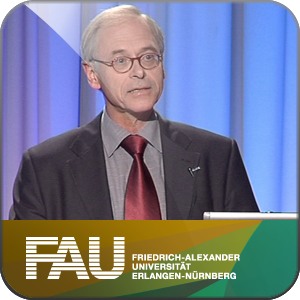 Prof. Dr. Klaus Herbers
Zugänglich über
Offener Zugang
Dauer
00:56:47 Min
Aufnahmedatum
2018-05-29
Hochgeladen am
2018-06-04 10:32:18
Sprache
en-US